Claim, Evidence, and Inference in a Persuasive Message
Claim, evidence, and inference are easier to separate when you identify what is asserted, what supports it, and what conclusion the message invites.
A claim, evidence, and inference can appear in a single sentence, but they do different jobs. A message may assert that a new school policy improved attendance, point to a set of attendance records, and invite readers to conclude that the policy caused the change. Separating those layers makes the argument easier to assess without dismissing evidence or accepting more than it can support.
The distinction is useful in news reports, campaign materials, workplace emails, product descriptions, and ordinary conversation. It asks three concrete questions: What is being said? What support is offered? What conclusion am I being asked to draw from that support?
What is a claim in a persuasive message?
A claim is a statement presented as true or worth accepting. It may describe something, explain why it happened, judge whether it is good or harmful, or recommend an action. Claims can be modest or sweeping, explicit or tucked into a headline.
Consider “The library extended its evening hours.” That is a descriptive claim. “The change makes the library more useful to working families” adds an evaluation. “The city should extend the hours at every branch” recommends a policy. The later statements reach beyond the basic description, even if they sit next to it in the same paragraph.
To find the main claim, ask what the writer most wants the reader to believe or do. A message can contain several supporting claims, but one often carries the argument. In a request to fund a library program, the central claim might be that the program merits continued funding; statements about attendance or community demand may serve as reasons for it.
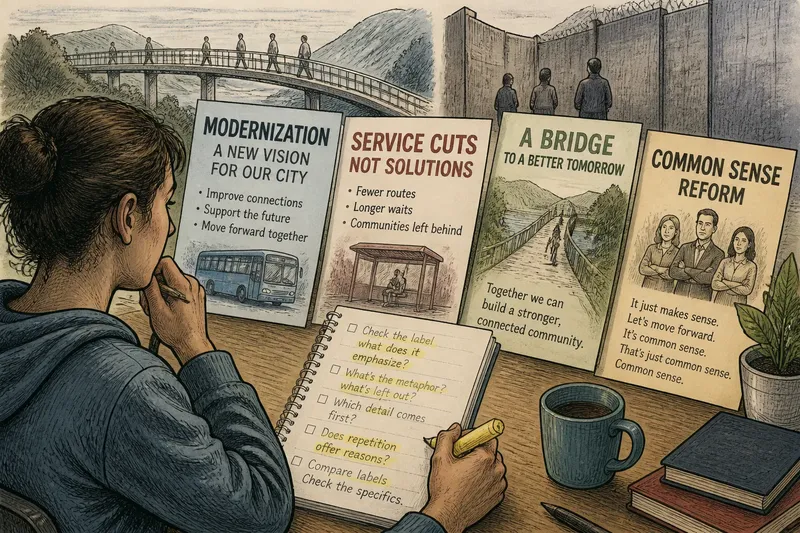
Headlines and slogans can make this harder because they compress or intensify a point. A headline may say, “New schedule transforms the library,” while the text reports only that evening hours were added. Treat the headline as a claim to examine, not as a neutral label for the details below it.
What counts as evidence for a claim?
Evidence is material offered to support a claim. It can include records, direct observations, documents, images, expert analysis, or testimony. A sentence that sounds confident is not itself evidence merely because it is stated with certainty.
Evidence should be specific enough to inspect. “Families love the new hours” tells the reader little about who was asked or what they said. A summary of comments from named public meetings, with the scope of those comments made clear, gives the reader more to evaluate. It still may not represent everyone who uses the library.
Ask what the evidence directly establishes before asking what it might imply. A sign-in sheet can record visits. It cannot, by itself, explain why people came, whether the visits were useful, or what would have happened under a different schedule. A photograph can show a scene within its frame; it cannot automatically establish what happened before or after it.
Evidence also differs in relevance. A glowing review of a library’s children’s room may be genuine but have little bearing on whether later hours help adult learners. Good support is not simply nearby in the message; it connects to the claim at issue.
What is an inference, and how does it differ from evidence?
An inference is a conclusion drawn from evidence and other assumptions. It can be reasonable, but it is not the same thing as the material that prompted it. The reader, writer, or speaker may make the inference, and persuasive messages often leave it unstated so that it feels self-evident.
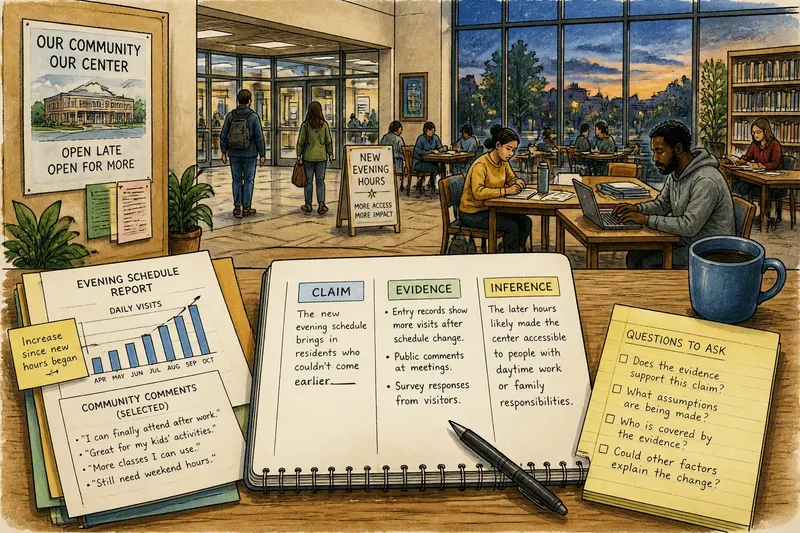
Suppose a report says that more people entered a community center after its evening schedule changed. The increase is an observation if the records support it. “The later schedule caused the increase” is a causal inference. “The center should keep the schedule” is a further recommendation. Each move may be defensible, but each needs its own reasoning.
One useful test is to insert the words “so this means.” If the message says that attendance rose, then “so this means the schedule worked” marks a conclusion rather than another observation. Ask what assumptions connect the two. Perhaps the schedule changed at the same time as a popular class began; perhaps records count entries rather than individual visitors. Those possibilities do not disprove the inference, but they show what it depends on.
Imagine a neighborhood group announces that the community center added evening hours and then recorded more visits. The group concludes that the schedule brought in residents who could not attend earlier. A careful reader can recognize the increase as the reported evidence, the new schedule as a possible explanation, and the claim about previously excluded residents as an inference that would need information about who visited and why.
How can you separate claim, evidence, and inference while reading?
Mark the message’s layers in plain language rather than relying on labels the writer chose. Write down the assertion, name the support, and state the conclusion that links them. If a sentence does two jobs, split it into parts.
- Claim: What statement is the message asking me to accept?
- Evidence: What specific material is offered in support?
- Inference: What does the writer conclude from that material?
- Assumption: What must be true for the conclusion to follow?
- Scope: Does the support cover the same people, place, and time as the claim?
These prompts are especially useful with sentences that bundle facts and judgments. “The district’s reading program raised achievement, so it should expand” contains a causal claim, an implied link between program participation and achievement, and a policy recommendation. The underlying records might document test results, but the reader still needs to know whether they speak to the causal claim and to expansion beyond the students already served.
Keep the first pass descriptive. Instead of writing “the evidence is weak,” note “the message cites attendance records but does not say who was counted.” That observation identifies a gap without pretending the claim must be false. It also leaves room for support elsewhere in the message.
What should you ask when the reasoning makes a leap?
Does the evidence support this particular claim?
Check whether the support addresses the same point as the assertion. A record of program enrollment may show that people signed up, but it does not by itself show that the program improved their skills. A relevant piece of evidence can still support only a narrower claim than the one being made.
Could another explanation fit the evidence?
When a message says one event caused another, ask what else changed or could account for the result. A plausible alternative does not settle the question; it identifies a competing explanation that the argument should consider. Causal claims generally require more than the fact that two things occurred together.
Does the conclusion reach beyond the evidence?
A small set of comments may suggest that some participants valued a service, without establishing that all residents support it. Notice changes in scope, such as a claim moving from one neighborhood to an entire city or from a short period to a lasting trend. The broader conclusion needs support that matches its reach.
What information would make the inference stronger?
State what is missing in concrete terms: a clearer time frame, a comparison, the method used to collect responses, or details about who was included. This is more useful than demanding “more proof” without saying what kind. It also helps distinguish a question that could be answered from a disagreement about values.
How can a message be persuasive without proving its conclusion?
Persuasion does not always aim to establish a claim beyond reasonable doubt. A community group might reasonably ask readers to consider a program based on limited local records and residents’ accounts. The message becomes misleading when it presents a tentative inference as if the evidence directly recorded it.
Notice the verbs and connecting phrases. “Shows,” “confirms,” and “proves” can imply that evidence settles a matter. “Suggests,” “is consistent with,” or “may indicate” leave room for uncertainty. Softer wording is not automatically more honest, but the strength of the language should fit the strength and scope of the support.
It is also possible for evidence to be sound while a recommendation remains debatable. Attendance may have increased, yet readers may disagree about whether the additional staffing or operating demands are justified. That is a judgment about priorities, not a discovery that the attendance record is false. Keeping factual support and value choices distinct makes disagreement clearer.
Which parts are not worth overanalyzing?
Not every sentence needs a full argument map. A routine statement such as “The meeting begins at six” may call for a quick check of the schedule, not an extended inquiry into hidden assumptions. Reserve closer attention for claims that carry consequences, make causal leaps, generalize from limited support, or urge a decision.
It is also not useful to treat every inference as a flaw. Readers infer constantly, and some conclusions follow well from the available evidence. The point is not to refuse conclusions but to see where the evidence ends and interpretation begins. That boundary lets you judge the reasoning at its actual strength.
When you separate claim, evidence, and inference, a persuasive message becomes easier to read with both care and proportion. You can accept a recorded observation, question the explanation attached to it, and still consider the recommendation on its own merits. The most useful response is often a precise one: this part is supported, this part is inferred, and this further information would help decide how far the conclusion should go.