How a Caption Shapes What a Picture Seems to Show
Learn how photo captions steer interpretation, spot clues in wording and layout, and decide when an image pairing needs more context.
A caption can turn an ordinary photograph into an apparent record of a specific event. In image interpretation, the words beside a picture may name a person, assign a role, or link the scene to a larger story. Those choices shape what readers notice, even when the photograph itself remains unchanged.
Captions direct attention through wording
Imagine the same photograph of a person beside a closed storefront. “Shop owner surveys the damage” presents the person as the owner and implies that the storefront has been damaged. “A passerby stands near a closed store” makes fewer claims. The difference is not just tone: each caption directs attention toward a different story.
Words such as “vandalized,” “abandoned,” “celebrates,” or “fleeing” carry interpretations that a still image may not settle. More restrained wording can also influence a reading by emphasizing one detail over another. A caption can be informative and selective at the same time.
That selectivity is not automatically a flaw. Captions often provide useful names, places, and event context that cannot be recognized from the image alone. The practical question is whether the wording clearly signals what is visible and what comes from outside the frame.
Read the image and caption as separate design elements
Captions appear in a visual arrangement, not in isolation. Their font, position, spacing, and proximity to a photograph can make a connection seem obvious. In a collage, a social feed, or a page with several images, nearby text may belong to a different picture or describe a broader story rather than the precise scene.
Check the visual link before reading the words as a label. Look for a caption directly beneath the image, a matching number or letter, a credit line, or a clear border separating one item from another. If the layout is cramped or the image has been reposted, the pairing may be uncertain. Proximity alone does not establish which picture a sentence describes.
Cropping matters here, too. A tight crop can remove signs, landmarks, or nearby activity that would help identify a setting. A screenshot may omit the original caption or the publication’s surrounding explanation. When those elements are missing, avoid treating a repost’s arrangement as the original context.
Notice the claims a caption adds
Rather than judging a caption as simply true or false at first glance, identify the kind of information it supplies. This makes it easier to see which details could be checked against the photograph and which require context beyond it.
- Identity: If the caption names someone or gives them a role, check whether the image or accompanying source identifies them; if not, keep the name or role unconfirmed.
- Time and place: If it states where or when the photograph was made, look for a publication credit or source context; if those are absent, treat the location or date as unresolved.
- Action: If it describes what someone is doing, compare the verb with the visible movement; if the action is ambiguous, use a narrower description such as “stands beside” or “walks toward.”
- Motive or emotion: If it says why someone acted or how they feel, look for supporting context beyond a facial expression or pose; if none is available, do not infer intent from appearance alone.
- Cause: If it attributes damage or a change to a particular event, check for context that links the event to the scene; if the link is missing, describe the visible condition without assigning a cause.
- Consequence: If it says what happened afterward, look for a source that documents the outcome; if the image and caption supply no such context, leave the result open.
These decisions are about how firmly to read the wording, not a verdict on whether it is accurate. A caption may rely on reporting, a photographer’s notes, or information from someone at the scene. The image can illustrate that account without independently confirming every part of it.
Ask what the frame and crop leave unseen
A photograph records a selected view at a particular moment. The edge of the frame might cut off a second entrance, a line continuing around a corner, or the activity that explains why someone is present. A still image also cannot show what happened immediately before or afterward.
Questions about missing context should be specific. Would a wider view reveal a sign or another part of the scene? Would a sequence of images show whether a person is arriving or leaving? Would the original publication identify the location? Each answer points to a different way of checking the caption, rather than inviting guesses about whatever is outside the frame.
It is not worth trying to read a stranger’s motives from a still face or to identify a location from a vague patch of background. Those clues are often ambiguous. Focus instead on the wording that matters to the story and ask what kind of source could support it.
When should you question a photo caption?
Can one image fit more than one caption?
Yes. A person looking toward a damaged fence could be an owner, a neighbor, or a passerby, and the photograph may not distinguish among those possibilities. Compare the role and explanation in the caption with the information available around the image.
Can a photograph establish someone’s motive?
A still picture can show a gesture or expression, but similar appearances can have different explanations. Treat claims about intent as context supplied by a source, not as something a facial expression proves by itself.
What if the caption names a place or event?
Look for the original publication, a photo credit, or accompanying reporting that connects the image to that place or event. If the connection cannot be traced, keep the identification tentative rather than relying on a familiar-looking background.
How can I describe a picture without adopting its framing?
Use plain terms for visible objects and actions, such as “three people stand beside a bus stop.” Add claims about identity, emotion, or purpose only when the image’s context supports them.
Work through the wording before settling on a story
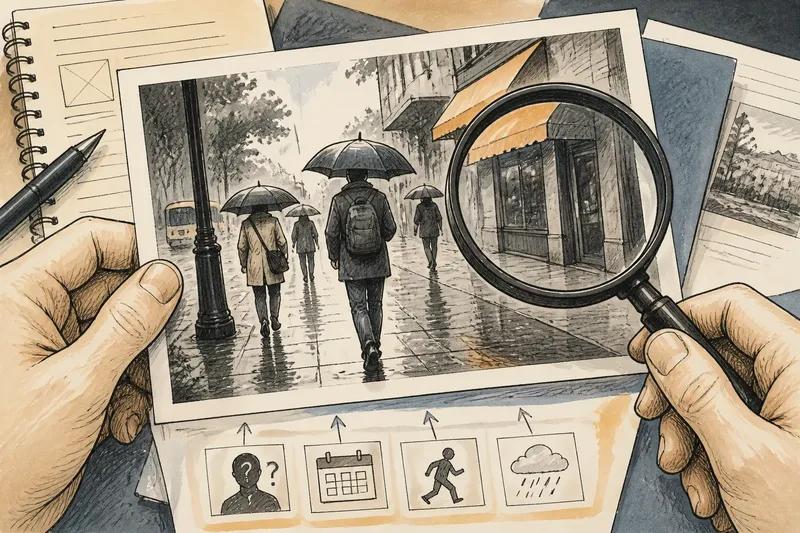
Say you encounter a photograph of people carrying umbrellas on a wet sidewalk. Its caption reads, “Commuters struggle through another storm.” The visible details are umbrellas, a wet-looking sidewalk, and people walking. The caption adds that they are commuters, that they are struggling, and that the weather is another storm. Those claims may have support elsewhere, but the photograph alone does not establish them.
Next, check the presentation. If the image sits beneath a clearly linked caption in the original article, the pairing is more secure than in a cropped repost with no credit. Then identify what could clarify the remaining claims: the article may identify the weather event, while a photographer’s caption or accompanying reporting may explain the people’s destination. If that context is unavailable, a careful description can stay with people walking under umbrellas on a wet sidewalk.
For a quick reading, keep three questions in mind: What does the frame visibly include? What does the caption add? What source would connect those added details to this particular image? This approach to image interpretation makes room for captions to inform readers while keeping their visual framing in view. When you share a photograph, retaining its original caption and credit also helps others see where its context came from.